03 / Design Leadership
February, 2024Design(er) as an Input
Thoughts on adaptive leadership, balancing pragmatism, and building an effective design team.
I believe in adaptive leadership. That belief was shaped over many years in my career, where I had the opportunity to work both as an IC and as a manager, across startups and corporate environments.
Although the contexts and rules were different, it always came down to the same question: how to contribute effectively to a team, or how to lead one effectively.
On the leadership side, being adaptive means functioning as an orchestrator who keeps pragmatism in close sight while not losing focus on where to sail.
Embracing new technologies and tools as a team, and staying adaptable through strategy or organizational change, is essential. On the leadership side, it means demonstrating tangible ROI by showing reduced cycle times and making smart decisions about talent and resources. Smart does not mean budget cutting. Smart means consistently articulating the why behind decisions.
The teams that consistently ship well are not the ones with the most senior designers. They are the ones where collective intelligence is directed at the right problems based on each person's strengths; where designers co-own a product end to end and feel accountable for outcomes; and where "cleverly opinionated" is treated as a professional asset, not a liability.
Which protocols make this happen?
One team member is the key to another's lock
Every designer has a skill profile: a distribution across data analytics, HCI, user psychology, product management, and business fluency. That profile is never flat. It has peaks where someone truly excels, and valleys that are either by choice or by circumstance. The mistake most design orgs make is trying to flatten those curves, to produce uniformly "complete" designers who are competent at everything and exceptional at nothing.
The diagram below shows what a healthy team actually looks like: four designers with distinct, partially overlapping skill distributions, each with a clear spike. Overlaid as a team, the combined coverage is comprehensive, and every gap one person has, another fills.
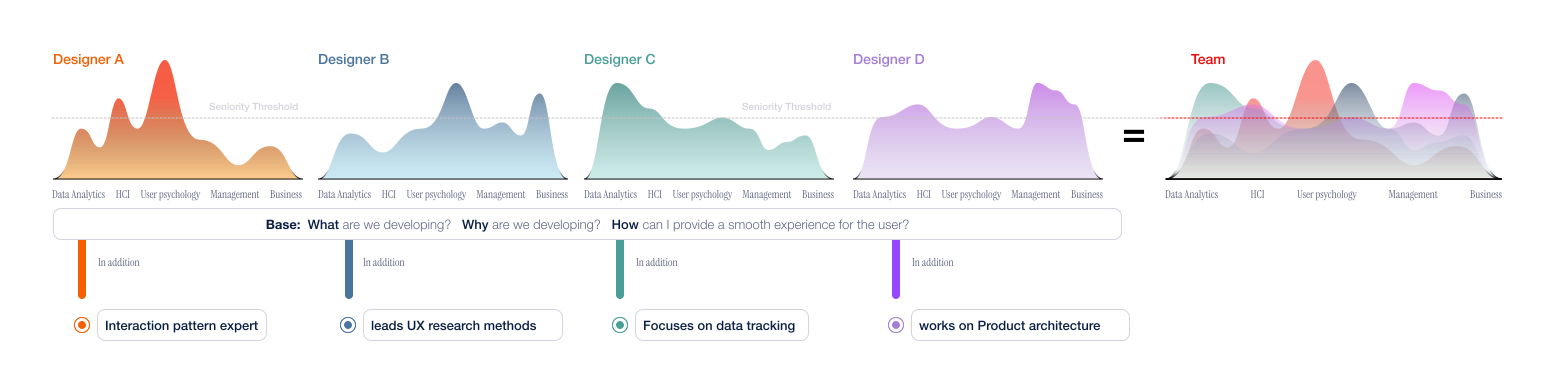
Skill distributions across five dimensions: each designer spikes differently, covering the team's full range
The specializations look like this in practice:
Why this benefits everyone, not just the business
The team approach significantly benefits both individual careers and the business. For individual designers, it deepens expertise where they already excel, which is where the most satisfying work happens. But it also exposes each person to the spikes of their teammates, broadening their toolkit over time through proximity rather than forced rotation. The result is holistic growth that doesn't require sacrificing depth to get breadth.
From a business perspective, strategically combining diverse skills ensures comprehensive coverage across all development domains. Blind spots and bottlenecks become visible, which is itself a hiring strategy. When you can see where your team's collective curve dips below the threshold, you know exactly what your next hire needs to look like. Not the most impressive portfolio. The most complementary profile.
This is what I mean by the designer as an input. Not a deliverable. Not a role that exists to produce artifacts at the end of a process. An input: someone whose distinct perspective, expertise, and ownership shapes what gets built, long before any screen is designed.
Adaptive leadership, then, is not a management style. It is an organizational design choice. It asks: do I have a team where each person's strength is the answer to someone else's gap? If yes, the system is resilient. If not, the strongest person carries everything, and when they leave, so does the coverage.